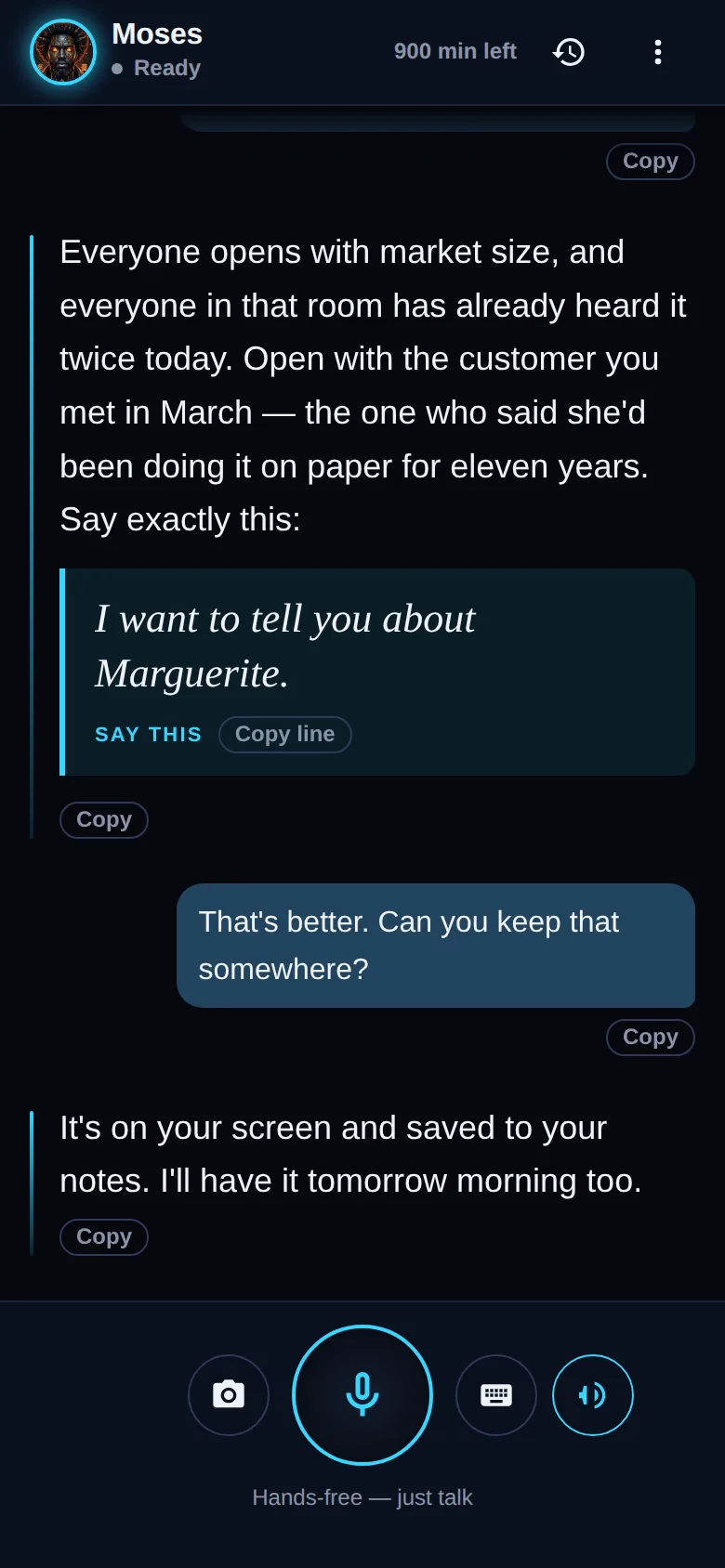
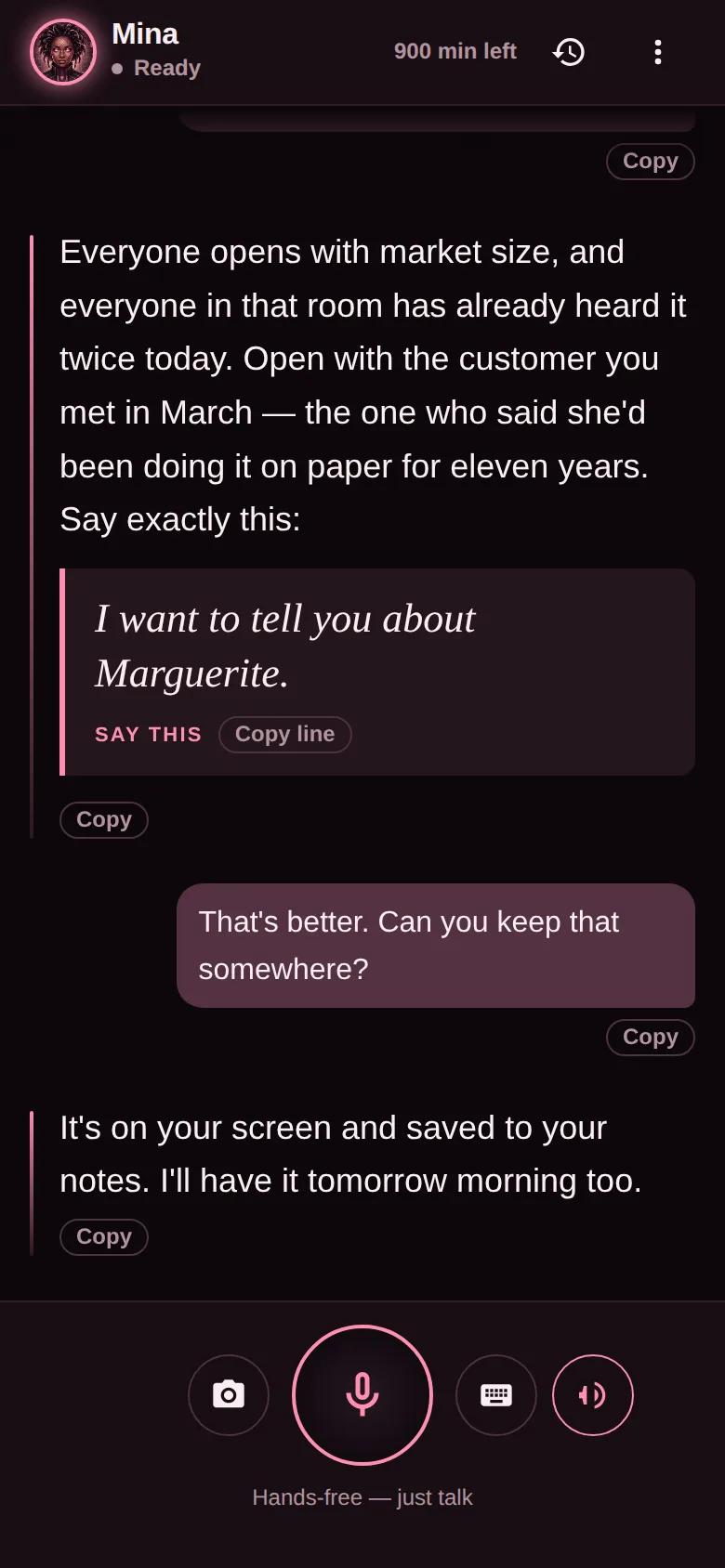
Will they actually remember me?
Yes — that is the point of them. They keep what matters between conversations: your name, the people in your life, what you are working through. You can see exactly what they remember in the app, correct anything that is wrong, and delete any of it. Nothing is hidden from you.
Can I read back an old conversation?
Yes. Every conversation is kept word for word for 30 days, so you can open it in the app, search it, and read what was said. After 30 days the transcript is deleted automatically and only the short summary remains. You can delete any conversation sooner, or all of them at once.
What can they actually do?
Talk with you properly, and get things done. They search the live web, work through real analysis and calculations, keep your lists, add things to your Google Calendar, look at a photo you send or at what your camera or screen is showing, remind you of things even when the app is closed, and write you a document — a comparison, a plan, a draft — that stays on your screen and in your account.
What can't they do?
They only reach you first if you turn notifications on — then reminders arrive with the app closed, and you can opt in to an occasional check-in. Without that, nothing happens unless you open the app. On an iPhone, notifications need the app added to your Home Screen. They cannot read a file or document you upload, or open a specific web page you link to. And they are an AI: they can be wrong, so check anything that matters.
Is this therapy?
No. Moses and Mina are AI companions for adults — good company and a straight read, not therapists, doctors or an emergency service, and they cannot contact anyone for you. If you are in crisis or thinking about harming yourself, call your local emergency number; in the United States you can call or text 988 at any hour.
Do I have to talk out loud?
No. Voice is the point, but you can type instead at any time, and the whole conversation stays on screen either way. Hands-free means you just talk; you can also hold a button, whichever suits where you are.
Moses or Mina — can I change my mind?
Yes. You pick one when you sign up and can switch from the menu whenever you like — what they remember about you carries over. Moses is the steady one who grounds you and leaves you something to do; Mina is the one who notices what you did not quite say and will not let you slide off it. Try them both on the free demo first.
What happens when the trial ends?
Nothing is charged. The trial is seven days with about half an hour of voice and no card required — if you do nothing, it simply stops. Move up only if they have earned it.
Can I cancel?
Any time, from PayPal, with no lock-in and no cancellation step to hunt for. You keep the rest of the period you have paid for.
About what you tell them
You will end up saying real things to Moses or Mina, so it is fair to know where it goes. Your conversations are used to run the assistant and to let it remember you — not sold, to anyone. Your password is stored only as a secure hash; we never see it.
Speech is processed by Google to hear and answer you, and deeper reasoning, web searches and photo understanding run on Anthropic. Each handles data under its own privacy policy.
If you arrived from an advert, Meta is told that this page was visited and, if you go on to create an account, that a signup happened — so we can tell which advert was worth running. It is never told anything you say to Moses or Mina. If your browser sends a Global Privacy Control or Do Not Track signal, nothing is reported at all.
You can take it all back. Delete a single conversation, clear everything the assistant has learned about you, or delete your account entirely from inside the app — that removes your memory, transcripts, notes, lists and any connected accounts. The full detail is in the privacy policy.